


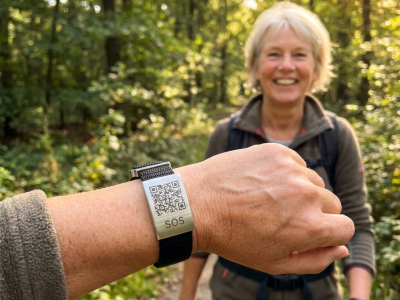
What should be on an SOS bracelet? (And what to leave off)
An SOS bracelet is only as good as the information it carries.
In an emergency, first responders have a few minutes to decide what to do — and in those minutes, a bracelet showing only a name is useless, and one crammed with irrelevant details is worse.
Here's what belongs on it, what you deliberately leave off, and why that difference literally saves lives.
The 5 things that always belong on it
1. Your first and last name.
Responders address you, look up your records and inform the hospital. Without a name, nothing starts.
2. Two emergency contacts — not one.
The biggest mistake we see: a single emergency number. If your partner is standing next to you at the accident, or doesn't pick up, the trail goes cold. Always add a second contact: a son or daughter, a neighbour, a friend who's almost always reachable.
3. Medical information a responder needs to know right now.
Think: diabetes, epilepsy, a heart condition, blood thinners, a pacemaker. The rule of thumb: if it gets in the way of standard treatment, it belongs on your bracelet.
4. Allergies that are dangerous during treatment.
Penicillin, contrast dye, latex. Hay fever doesn't need to be on there — an allergy a paramedic could trigger with an injection does.
5. Conditions that explain behaviour.
Dementia, autism, epilepsy, hearing loss. A bystander who understands why someone seems confused calls the right help faster — and stays calm.
What to leave off
- Your full address. A found bracelet with a name and address is an invitation to burglars — the finder knows you're not home.
- National ID or insurance numbers. Responders don't need them in the field, and they're gold for identity thieves.
- Your complete medical history. That knee surgery from 2019 is just a distraction. Stick to what's acutely relevant.
The problem with engraving
With a classic engraved bracelet, you make these choices once — and then they're fixed. Your daughter changed her phone number? New medication? Time to order a new bracelet and have it engraved again.
That's why a DynaTag works differently. The bracelet carries a QR code; you manage the information behind it yourself and update it anytime. One scan with an ordinary smartphone shows responders everything: who you are, who to call, what they need to know. No app, no subscription. And your profile holds more than an engraved plate ever could — in multiple languages, which matters the moment you hike or cycle across a border.
Who is this for?
- Hikers and athletes who head out alone — the group for whom "my phone is in my pocket" is no plan when that pocket is out of reach.
- Seniors who stay independently active, and their families who'd like to keep it that way.
- Children in busy places: campsites, theme parks, the beach.
- Anyone with a condition that needs explaining when you can't explain it yourself.
The checklist
✅ First and last name
✅ Two emergency contacts (name + number + relationship)
✅ Acute medical info (conditions, medication that affects treatment)
✅ Dangerous allergies
✅ Conditions that explain behaviour
❌ No address, no ID numbers, no medical history
Five minutes to fill in. Then you never think about it again — until the moment someone else has to read it for you.
Share this content